Sijainti:
Homepage | Description of the exhibition Nature Speaks in the Kalevala
 |
|
 |
|


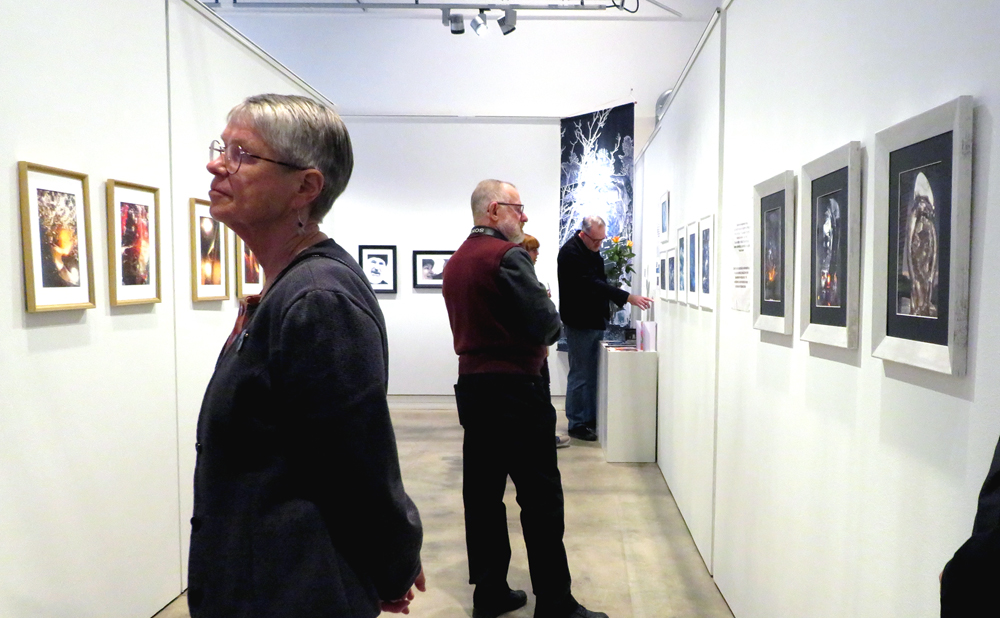
Welcome to the Nature Speaks in the Kalevala art exhibition at the gallery of the Cultural Centre Caisa.
Text Board
The Kalevala Was Created to Answer a Need
The birth of the Kalevala is connected to the idea of nation-states, national culture and national history that arose in Europe in the 19th century.
At that time, Finland was developing into a nation, and needed economic, social and cultural characteristics.
The Kalevala is based on the oral, sung folk poetry tradition of the Baltic Finnic peoples, runic song, which is orally passed down from one generation to the next.
The songs have come into being as a result of communal creation and storytelling.
1 Switch (Vitsa)
The sculpture shows a distinct bird figure with its wings raised and its head arched back. The sculpture is elegant and dynamic, and it may give the impression of a bird taking flight.
2 Twinkle (Tuikahti)
This sculpture glows orange, which is due to the lighting or the internal reflections of the ice. In it, two birds may be seen back to back or bodies on top of one another, or the work may be seen as completely non-representational.
3 Beloved (Armas)
The picture shows a bright and slightly stylised, intertwined pair of birds. The sculpture communicates closeness and protection, so it may have a mother bird and a chick.
4 Spatter (Vihmo)
In the ice sculpture, two heads are clearly distinguishable next to each other. Maybe the birds are mating. The sunset in the background creates a warm contrast to the cold ice sculpture.
5 Virtuous (Hyveä)
This is again an orange-toned image. The figure in the tall sculpture resembles an upward-looking, swan-like bird. It may be thought of as a symbol of nobility and peace.
6 Maiden (Impi)
The sculpture is transparent and therefore looks light. There, too, one may see two birds side by side. The pair is in dynamic motion and interacting with each other. The bright sculpture creates a calm impression.
Text Board
Might - Gods and Elves

The figures in the Might ice sculpture series are studies of ancient Finnish gods, of which there are only descriptions of runic songs and stories and the images they create, but no realistic images of any kind.
The Might images do not aim to be likenesses, but they express power and upwards reaching emotion. Perhaps the ice images can be said to have been guided by the gods.
In the Might images, I have tried to capture mighty power. The purpose of the strong natural colours is to remind us that people have previously considered themselves to be part of nature and its cycle, and that they still are.
Pictures: The Gaze of Ice
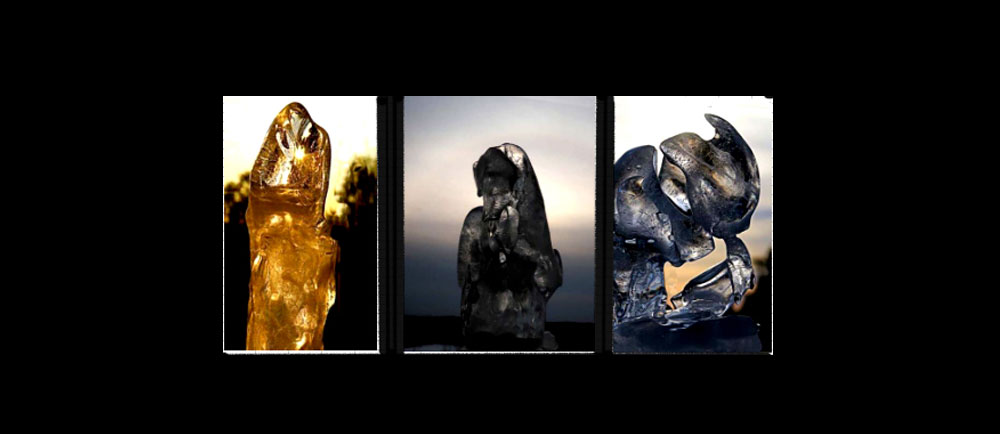
In all the three The Gaze of Ice sculptures, the cold clarity of ice is combined with the emotions and stories that their shapes may evoke. The sculptures are still moments where nature and emotion are combined. The ice sculptures are abstract shapes, which leaves room for recognition and the awakening of one's own emotions.
7 In the Sun
The sculpture on the left, illuminated in golden yellow, rises upwards, narrow and sleek. It may be thought of as resembling the head of an animal or bird with its beak up. The surface is covered in a bright glow that creates the impression of vitality and warm inner light. It may also bring to mind something protective or observing.
8 Longing
The ice sculpture in the middle is dark and low. In it, one may see two intertwined figures who seem to be embracing or leaning on each other, which creates a deep human feeling to the work. It is a quiet and peaceful moment of presence and intimacy. The dim lighting in the background is part of the atmosphere of the work.
9 Tasty
The sculpture on the right is a dynamic and slightly larger sculpture in which two shapes appear to meet or move towards each other. The ice-clear surface of the sculpture is chipped. The shapes resemble birds that peck at each other gently. One may just as well see human figures having a shared moment in it. The sculpture exudes interaction and movement.
Text Board
Birds in the Kalevala In the Kalevala, birds are part of the world order. They bring messages and prophecies. Birds have mythical meanings and were thought to be messengers between this world and the world hereafter. After all, they could move effortlessly both on earth and in the heights of the sky.
The birds have many different tasks, for example the eagle representing higher powers, which helps Väinämöinen in distress at sea.
The task of the Swan of Tuonela is to guard the River of Tuonela, and catching it is fatal. The swan symbolizes death, but also loyalty.
Canvas Print
10 Land of Birds
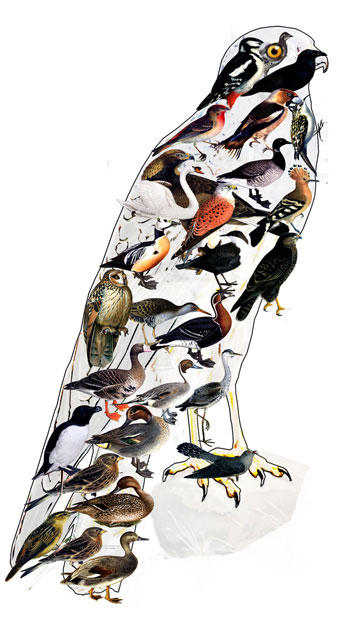
The image shows a large figure in the shape of a bird, the outline of which serves as a frame for smaller bird images composed inside the frame. The collage consists of about twenty birds of different sizes and colours, which are drawn very realistically. The plumage, beak and colours can be seen in detail. The big bird that serves as the frame might be a large bird of prey, a hawk or an eagle.
Text Board
The forest is always present and near. Every Finn is only a couple of hundred metres away from the forest.
A miracle awaits in the forest. The heart rate slows down, blood pressure drops and the mind calms down. If we are able to turn off the phone also, we will be gifted a moment of peace and unavailability. Stress eases, too.
In the forest, we can also find an ancient gatherer in ourselves. We can experience the joy of seeking, discovering, and recognising.
A felled forest does not respond even if it is shouted at. Only old trees speak to a person if they have ears to hear.
Image:
The Blue of the Forest
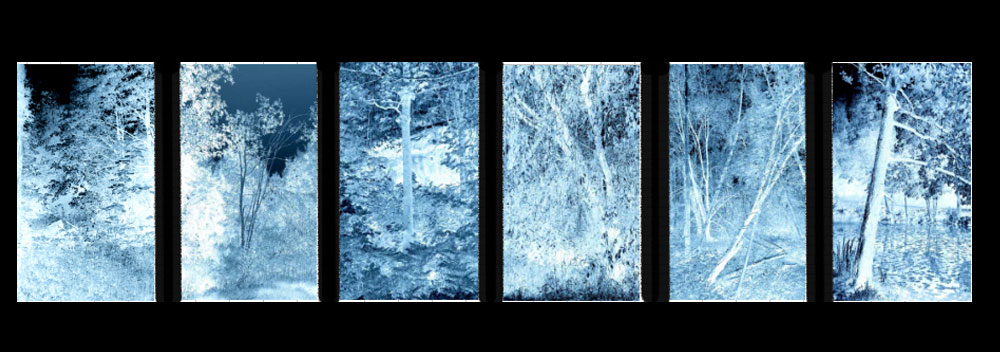
Here are six pictures in a row that depict forest environments. The images have been edited to a strong negative shade (from blue to white), which creates a strange, even dreamlike atmosphere in them.
11 Cut
The photo shows young deciduous trees and shrubs. Behind them, there may be an open meadow or field. There is sky behind the branches. Negative colours emphasize white and dark blue shades. The trees are light, the sky is highlighted dark.
12 Apart
In the middle of the picture, a couple of dark-trunked trees with smaller bushes at their roots can be seen. In the foreground, there is an open lawn and the sky can be seen above the abundant forest.
13 Clearing
In the middle there is a fairly sturdy tree trunk. In the foreground there is abundant vegetation from which the tree rises. In the middle of the picture, there is a light-coloured clearing, to which one may imagine a forest path leading.
14 Inclination
Several thin trunks, possibly birches, which are slanted from the lower right corner, leaning left up. The vegetation is dense, and only a little of the sky looms dark between it.
15 I Don’t Fall
The picture shows a small clearing with fallen and falling young deciduous trees. The abundant branches form a web-like surface against the dark sky.
16 My Growth
The picture is dominated by a sturdy pine tree in the foreground. It is leaning from the lower left front corner towards the centre line. There are branches only on the right side of the trunk, and they and the top extend over the edge of the picture. A pine tree seems to be growing on the shore. There are reflections in the water and one may think of there being small buildings on the opposite shore. The sky rises above them, sliding from light to very dark.
Adjacent wall in L-shaped inner wall
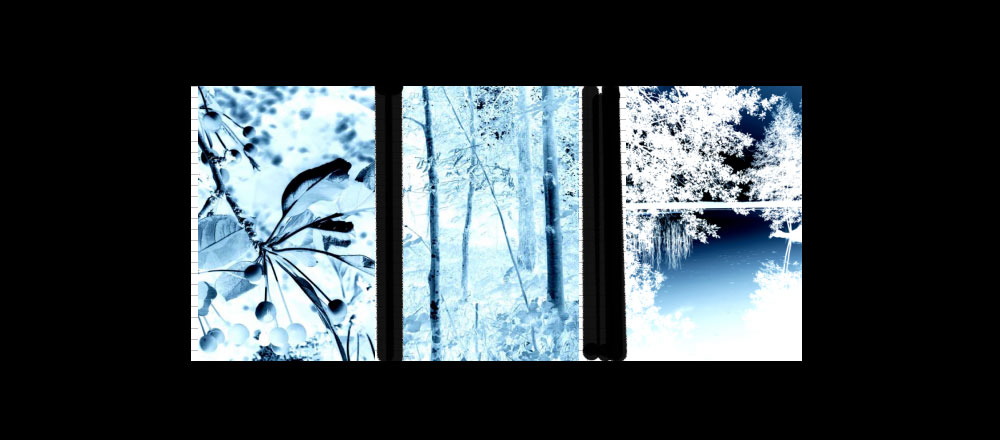
In the Blue of the Forest
All three blue pictures have been processed into negative images, i.e. the colours are reversed and the light areas are dark, and the dark ones are light. The result is a strongly contrasted image that emphasizes opposites.
17 Berry
The picture shows branches with sparse small round berries. Leaves and berries are clearly visible in the foreground, with more branches and berries in the background, which are blurry and create a strong impression of depth.
Due to the negative treatment, the leaves and berries appear light, while the background is darker. The image shows a close-up look at the details of nature.
18 My Path
The picture shows young, upright tree trunks. There is undergrowth on the ground. The atmosphere in the picture is calm. Its vertical rhythm dominates the landscape.
19 At Blue
The picture shows a lakeside landscape. On both sides there are abundantly leaved deciduous trees, between which a calm lake can be seen. The line of the opposite shore is in the middle of the picture, and the sky is reflected in the water.
The atmosphere in the picture is calm and the beach view has been depicted as a wider landscape than the previous ones.
Wall end
Nature Speaks in the Kalevala
Our early ancestors are thought to have come to Finnish peninsula 11,000 years ago from areas around current Spain, when the ice receded further north. Both genes and culture have also migrated from the Urals.
On the basis of ancient Finno-Ugric mythology, it can be said that genders and population groups have been more equal than elsewhere in the world. In the world of the Kalevala, differences and also deficiencies have been accepted, although folk poetry also speaks of harsh poverty.
The Kalevala is a gateway to ancient Finnish-Karelian culture, to myths
In the middle of the window wall
Nature Speaks in the Kalevala
Together, these two images form a pair with a contrasting colour scheme.
The bluish leaf tells of a cold night, while the light of the reddish-brown landscape tells of a glowing and warm day. The theme may be the cycles of nature – life and death, silence and power.
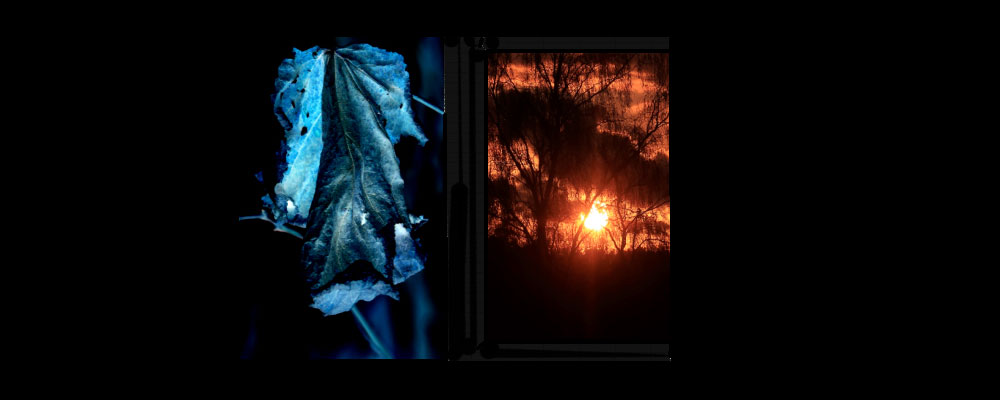
20 The Blue of the Leaf
The bluish leaf is a close-up of one large, withered leaf. There are shades of blue and dark purple in the picture, and the leaf looks frozen because it is illuminated with a cold, magical light. The leaf is wrinkled in structure, slightly ragged at the edges and full of small details such as veins and spots. The background of the leaf is dark, almost black, which makes also the leaf glow. The atmosphere in the picture is quiet and cool, like the first night of winter, when time stops, too.
Text board
Although the Kalevala is based on popular sung poetry, it is also largely Lönnrot's creation. He modified the material, composed events and plot structures, and also created verses and characters such as Aino and Marjatta, both of whom are role models for women who act independently.
The Kalevala is a whole mythical poetic world and an extensive narrative whole that includes in addition to epic material, also lyrical poems, origin-words and incantations.
21 Solar Reflection
The picture shows the reflection of the sun through the forest. It is either sunrise or sunset. The light of the sun glows in bright yellow and orange. The trees of the forest in the picture are like black shadows, and the light from between them creates glowing circles and fire-like reflections. The whole picture is warm-hued, as if the forest were on fire. Overall, the mood of the picture is warm and a little mystical. It might be a moment before a change or a prayer of nature.
Canvas print in the corner of the window wall and the right wall.
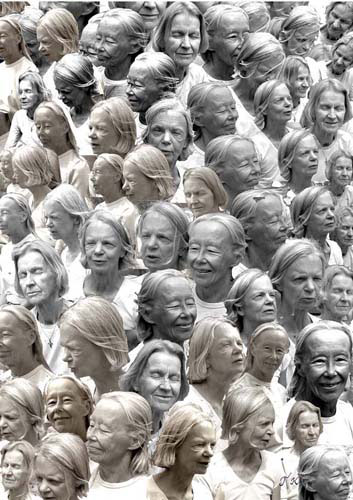
Story of Generations
The picture is a black and white photo collage with several dozen faces of women aging in different ways. The women seem to be one and the same person, only with different expressions and depicted from different directions. The woman smiles, looks in different directions and sometimes gets serious. The faces are close to each other and the whole forms a mosaic-like surface.
Text board
The folk poems on which the Kalevala is based are runic songs that were sung in ancient times in a variety of situations and were passed down as an oral tradition from one singer and generation to the next.
The poems follow the old Kalevala meter (trochaic tetrameter), which is characterized by alliteration, repetition and a fixed-length verse structure. Thanks to them, the poems were easy to memorise and remember. Of course, the poems were also modified.
Folk poems were collected especially in the 19th century, when they began to be published in written form as well. Thus, the old Finnish-Karelian tradition was recorded and preserved as part of literature and living folklore.
22 Respect
The photo is a black and white, strongly contrasted photograph of an elderly woman and an elderly man standing in a snowy forest landscape. The picture combines the harshness of the Finnish forces of nature with the essence of man. The atmosphere is quiet and respectful, but also hopeful. It also makes the picture mythical. The human figures may be like people contacting nature spirits or ancestors, e.g. ancient Finnish sages or healers.
The dark parts of the image are almost black and the light ones are almost white, which creates a graphic effect and a slightly mystical atmosphere in the image. In the winter landscape in the background, large rocks with snow and possibly ice on the surface can be seen. Tall, leafless trees rise in the background, which suggests that the season is the heart of winter. White streaks can be seen on the rock wall, which can be frozen water streams or snow accumulations in the grooves of the rock.
The clothing of the woman and the man in the picture is dark and resembles capes or robes, which creates ancient Finnish or shamanistic impression.
Both characters look up seriously and thoughtfully.
Their faces are the only bright and light spots in the otherwise dark figures, which emphasises their presence.
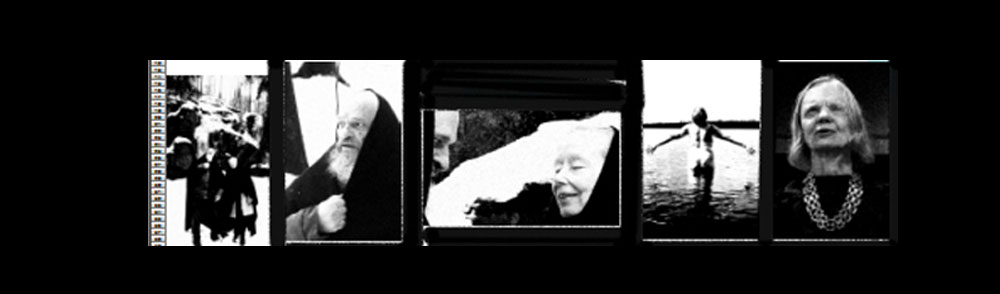
Next Images
There are four black and white, strongly contrasted images depicting people.
The images emphasize the feeling of connection to nature and spirituality. The characters may represent ancient Finnish people, sages, healers or elders of a community.
23 Will
The picture shows an old man with a full beard who wears a dark cloak. He seems to be looking slightly upwards. There is dark and light contrast in the background. The figure may bring to mind a shaman or an old sage.
24 Encounter
The picture shows an elderly woman smiling and looking calm. She is illuminated by a bright light, and the image exudes gentleness and wisdom. In the upper left corner of the picture, one can see a little bit of the full-bearded man from the first picture, who was described as shamanic.
25 Giving up
In the picture, a woman is standing in the water, her back to the viewer, her arms spread straight sidewars. The figure can be clearly sensed to be connected to nature. The water comes up above the knees of the woman. In the background, there is a narrow strip of the opposite shore and the sky.
26 Control
The picture shows a woman who is already quite old, whose blonde hair falls on her shoulders. Against the dark blouse, the impressive jewelry around the neck stands out. The gaze is directed straight ahead, and there is determination and dignity in the expression.
Text board
People of the Kalevala
The characters in folk poetry have been charismatic power figures, often tribal or war chiefs, whose heroic or miraculous deeds have been transformed into stories and poems.
What are today's Väinömöinens, Louhis, Joukahainens and Ainos like? With the choice of persons and images, I try to present the Kalevala characters living around us.
One of the central themes of the Kalevala concerns men's desire and attempts to get a wife for themselves. Folk poems created over hundreds of years feature many kinds of Väinämöinen, Ilmarinen and Lemminkäinen.
Images continue
The series of four images consists of black and white portraits. The facial images are plain and strongly contrasted, so that the light areas are almost white and the dark areas are almost black. The style of the photos emphasises facial expressions and emotions.
The pictures tell the story of people who could be ancient Finnish sages, healers or elders living in balance with nature. The images have a quiet, respectful and deeply human atmosphere. Each image also focuses on facial expressions and gazes, which brings the characters close to the viewer and makes of them almost mythical figures.
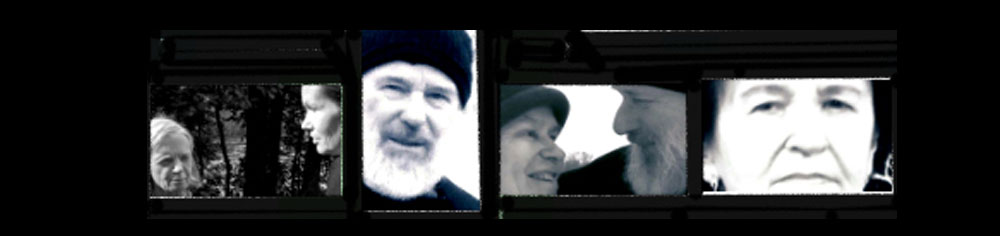
27 Daughter
The picture shows two people standing face to face or side by side turned partially towards each other in an outdoor space. The younger woman at the top right looks at the older woman at the bottom left with slightly searcihg eyes. The background is dark. The forest and other elements of nature are poorly distinguished. The picture has a quiet, almost festive atmosphere.
28 Gaze
The picture shows a man with a white beard and a dark hat. He looks towards the camera and smiles lightly. The man seems gentle.
29 We
The man and woman in the picture are looking at each other from a close distance, smiling very warmly. In the situation the couple's mutual connection and gentleness is crystallised. In the picture, you can sense the mutual respect and tenderness of the old couple.
30 Will
The photo shows a woman's face shot close-up, directly from the front. Her gaze is serious, almost severely thoughtful. The style of the image emphasises the strength of her expression, which is reminiscent of matriarchal power, as the woman is like a wise ancestor.
The part of the inner wall that is opposite the right wall
There are two sky images, with a partly cloudy, dramatic and colourful sky. The impression of natural forces and colours is emphasised in the images. The atmosphere of the pictures may be considered surreal.
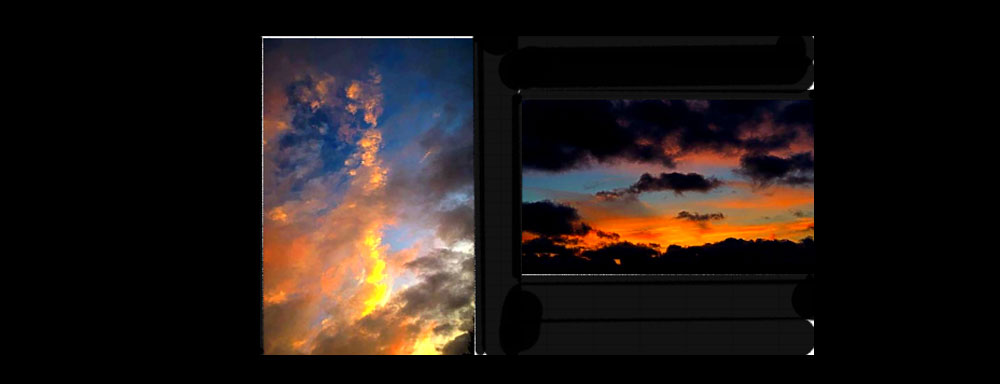
31 Shine
The one on the right is a horizontal sunset image filled with shades of orange, red, yellow, and blue. At the top, the sky is covered with dark clouds and there is glowing light on the horizon, which creates a strong contrast in the image. The lower part has equally dark silhouette-like ground surfaces.
32 Pillar of Clouds
The image on the left is a vertical image of the sky with strong warm colours: yellow, orange and purple, which rise like a pillar in the sky. Dark blue and blackish clouds frame the light. It is a sunset when the light breaks out from the clouds spectacularly.
Text board
The Earth and the climate have their own processes of change, which remind us that man is no master of creation.
During the Ice Age, the kilometers-thick glacier pushed the earth's crust down hundreds of meters compared to the current state.
The Ice Age ended 10,000–12,000 years ago. The earth's crust began to return towards the original. The land uplift was strong during the first thousands of years.
The ongoing global warming is visible in many ways. Winters are getting shorter and the growing season continues longer. Summers and waters are getting warmer. The living conditions of many species are becoming more difficult and species are facing extinction.
Canvas board in the corner
33 Blue Lightning
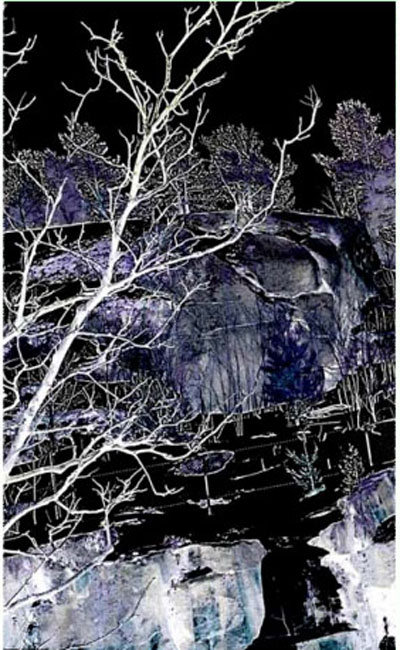
The picture is a negative image of a forest landscape. The colours in the image are reversed: the light spots appear dark and the dark ones appear light.
The picture shows a rocky landscape with bare rock on the foregroung and thin, leafless trees in front of it. The contours of the rock stand out strongly due to the contrast of light and shadow.
These images have a lot of play of light, colours and sense of movement. They are not completely realistic photographs, but might be artistic fantasies of space and the cosmic world. The images may be seen as visual poems of a cosmos full of movement, light and mystery.
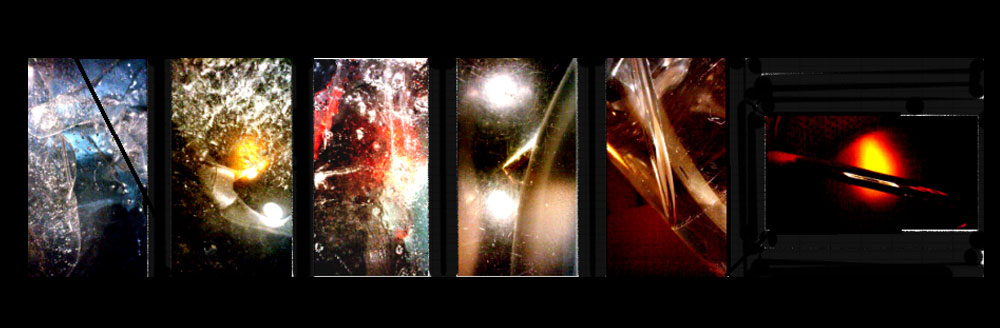
34 To Blue
The image shows silver and blue hued light trails that run diagonally from corner to corner on a dark background. The image may show nebulae or arcs of galaxies. There are also small dots in the picture that look like stars.
35 Splinters
This picture is warm-toned. The colours are yellowish and orange, as if the light source were some kind of sun-like core. The bright center appears to be emitting light through droplets or dust particles.
36 In Red
This image glowing with light is abstract. On a dark red and brown background, three points of light shine that seem to be reflected through some transparent surface. It is like looking at the light of the stars through frost or a lens.
37 Rising
The image shows long, curved lines that are golden or copper-coloured. The lines cut through the dark red background like rays of light or meteor trails in space.
38 Arc’s
Here you can clearly see shiny, golden light streaks. They resemble flowing energy or bending rays of light. The background is dark red and slightly translucent. The image has a powerful and dynamic atmosphere.
39 Ring’s
This image is darker and more mystical than the others. In the middle there is a bright, reddish-yellow glow that resembles a small sun. A dark, thin line runs through it, which may be thought to be a shadow or a ring. Could it be Saturn, for example?
Text board
Looking at the Stars in the Sky
Slow change wandered,
Like the wind from behind the mountains.
Man got their own place
On earth, in the world
And under the starry sky.
Surrounded by great silence,
The lightless darkness of the night.
The gaze rises,
Climbs to the heights.
And time stops.
Star-filled
Dome over everything.
Miracle. Bewilderment.
What is everything?
Do the gods walk there,
The rulers of heaven,
The governers of human life?
Or emptiness,
Utter darkness
Or a great promise?
Future priests, prophets
Future sages and scientists
It's all guesswork.
The circle of questions expands.
The same wonder remains
Also today
The evening darkens
And the starry dome of the night rises.
The darkness keeps silent.
The gaze rises and to the depths
Of space escapes.
The same is the orchard of the stars,
Same silence
Like from afar
Of thousands of generations.
Today
Like in the beginning of eternity
You wonder under the sky,
On the border between dream and reality.
The secret is still there.
You see, as was seen in the ancient days.
When time stops.
You can be idle and free,
An insignificant and small person
In a part of the great universe.
Tero
Text board
Water is a prerequisite for all life. Most of the surface area of the Earth is covered by water. Our bodies also have the same distribution: we are about 70% water.
Fresh water is the most important renewable resource. Still, clean, fresh water is not a given everywhere. More than a billion people live without clean drinking water, and more than half a million children die every year in the world as a result of dirty water or inadequate sanitation.
Fresh water was an important prerequisite for the development of agriculture. The first great cultures emerged by the side of large rivers. In Finland, too, population has spread along waterways.
Clean Water
Pictures
These seven single images show different shapes and movements of water surface. The images may have been edited so that the blue and dark colours are especially accentuated. Some of them resemble negative shades.
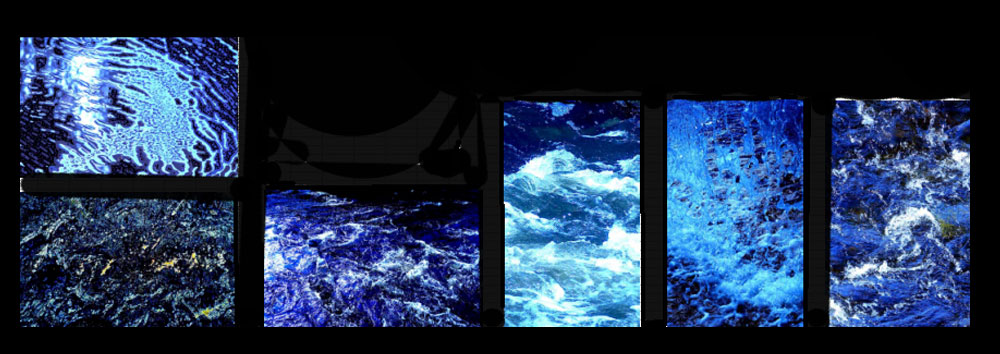
40 Reflection
One can see light rings and reflections on the surface of the water, possibly waves caused by raindrops or some other small movements.
41 In Surge
The picture shows dark water. The surface shows a dense structure that looks like seaweed.
42 Splashes
The water in this picture is clear and it is in motion. There is foam or swirl, perhaps it is a small rapids or a current.
43 Surf
Strongly foaming and swirling water, perhaps the waves of the sea or water whirling in a current.
44 Waterfall
Now we are looking at the surface of the water from above. The reflections form a dense, almost abstract surface. The wave-like movement of the water is a mixture of dark and brighter blue. The water is moving towards the right side of the image.
45 Vortices
The image shows violent vortices or even breaking waves. There's a lot of foam and momentum in the water, and the whole scene seems very energetic.
Text board
Swamps are an important part of the nature and also the culture of our country. Almost a third of the area is marshland.
Swamps serve as natural water reservoirs. They retain water and thus affect local water systems. They filter and regulate water flows and temper flooding.
Swamps maintain biodiversity and also play an important role in terms of the climate. Swamps are carbon sinks and carbon stores.
Peatlands are treasure troves of millenial, slow-forming peat, and peat has been used in many ways.
There are three adjacent ice sculptures on display, possibly photographed outdoors in a cold environment. The sculptures, which have irregular shapes, reflect warm light from the background, bringing out the brightness of the ice and the details of the surface. It may be thought that the mystical and meditative sculptures depict living beings. All three sculptures are like frozen moments, emotions or figures captured in the ice.
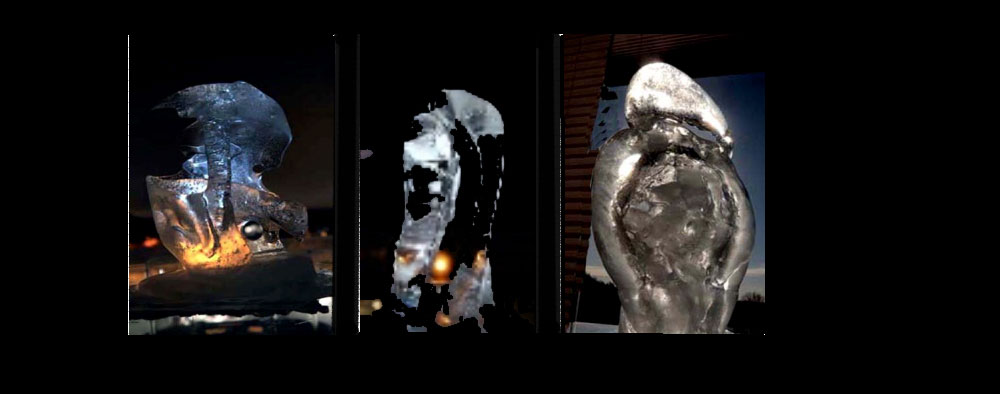
46 Held
The sculpture in the picture resembles, for example, the head of an animal or a bird, the top of which curves like a beak or a horn. The figure appears to be looking or bending down. The surface of the sculpture is glossy and bright, reflecting dark and yellowish light, which gives the impression of an inner glow.
47 Smile?
The picture shows a tall and rather narrow ice sculpture in which you can see two human-like figures hugging each other. Light is reflected softly from the surface, and the dim background emphasises the coldness and mystery of the ice.
48 Bare
The sculpture in the picture is more rounded and graceful in shape than the previous ones. It may remind one of a stone or some other hard, polished object. One can also see features in the sculpture that resemble a bird's head or a figure in a nest. The surface of the ice sculpture is partly frosted, so the light reflected from it makes it come alive.

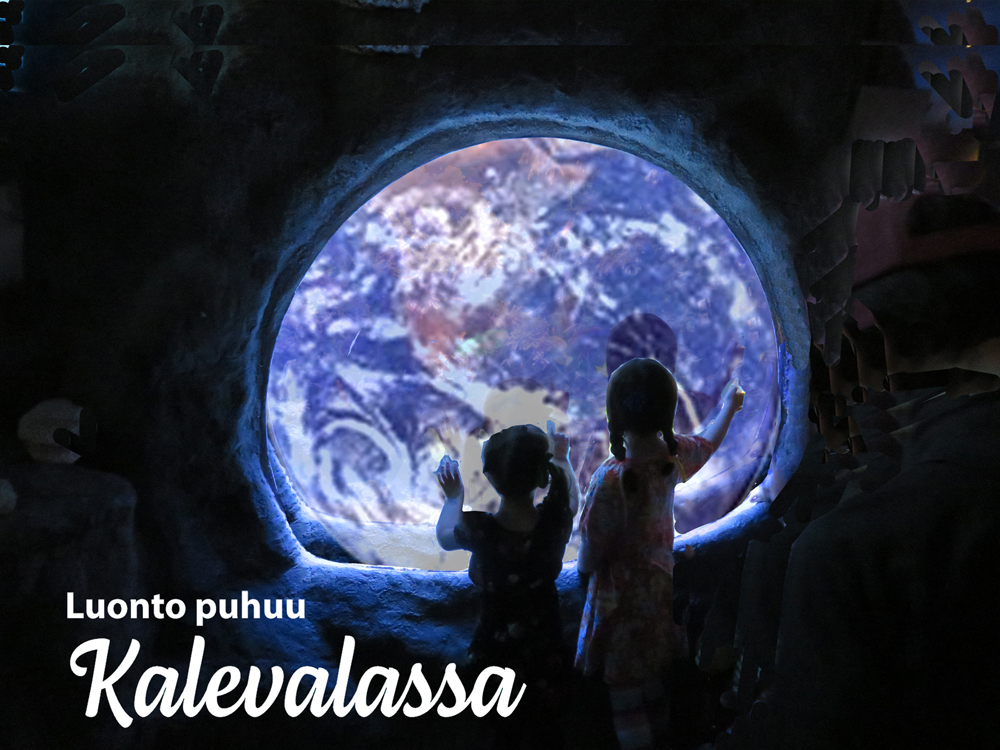
Welcome to the opening of Tero Kokko's photo exhibition on27.8.–25.9.2026 Galleria Joutsenessa Salossa
...
Read more

When I started reading the Kalevala in the early 2020s, there arose a lot of intersecting questions that I wanted to start to explore. I photographed, acquired source material and... ...
Read more

The Kalevala is Finland's national epic, on the basis of which the entire Finnish culture has been built, but what would the Kalevala have to say today? ...
Read more

This exhibition and the material that will remain on its website have only been possible with the help and work of a great many people. It would not have been possible to start to work... ...
Read more

This exhibition and the material remaining on its site have only been possible with the efforts of a great many people. I am very grateful to all the participants who have made their... ...
Read more

Tero Kokko is a visually impaired photographer who has received grants for his artistic work from Finnfoto, for example. ...
Read more
<< Nature Speaks in the Kalevala | Nature Speaks in the Kalevala >>
Homepage
Koskettava kuva
Kauneus on katsojan sormissa
Tero Kokko |
Rapakivenkuja 1 C 45 |
00710 Helsinki, Suomi-finland
Puh: 040-5594 739 |
saavutettavuus [at] omat.fi
|
www.terokokko.fi
Saavutettavuus fb
 |
|
 |
|

Kokko-Kokki Oy has been conducting website accessibility tests
in Finland
since 2003. The company is the oldest company
in Finland involved with accessibility issues.
Kiinnostavia sivustoja